
Mortgage closing costs typically range from 2% to 5% of your total loan amount and cover the processing, legal, and administrative services required to finalize your home purchase. These out-of-pocket expenses are paid upfront on closing day, separate from your down payment.
How Closing Costs are Typically Broken Down:
Below is an updated (June 2026) mortgage closing cost breakdown in a format suitable for your mortgage website. This aligns with the current CFPB/TRID disclosure structure (Loan Estimate / Closing Disclosure), though exact fees vary by lender, state, loan type, and transaction type. CFPB continues to note that purchase closing costs commonly run 2%–5% of the home purchase price, while refinance costs are often somewhat lower as a percentage, depending on escrow/tax setup. (Consumer Financial Protection Bureau)
Estimated Mortgage Closing Costs Breakdown (Updated 06-2026)
Home Purchase Mortgage Closing Costs
Category |
Fee Item |
Estimated Range (2026) |
Paid To |
Notes |
|---|---|---|---|---|
LENDER FEES |
Loan Origination Fee |
0%–1.0% of loan amount ($0–$4,500+) |
Lender |
Some lenders charge flat fees instead |
Underwriting Fee |
$600–$1,500 |
Lender |
Credit risk review |
|
Processing Fee |
$300–$900 |
Lender |
Loan file preparation |
|
Application Fee |
$0–$600 |
Lender |
Not always charged |
|
Rate Lock Fee |
$0–$500 |
Lender |
Sometimes waived |
|
Discount Points |
0%–3% of the loan amount |
Lender |
Optional buy-down of rate |
|
Flood Certification |
$15–$40 |
Vendor/Lender |
Required if applicable |
|
Tax Service Fee |
$70–$150 |
Vendor/Lender |
Common conventional fee |
|
Document Prep / Admin Fee |
$100–$500 |
Lender |
Varies widely |
THIRD-PARTY FEES
Category |
Fee Item |
Estimated Range (2026) |
Paid To |
Notes |
|---|---|---|---|---|
PROPERTY / VALUATION |
Appraisal Fee |
$500–$1,200+ |
Appraiser |
Higher for complex properties |
Reinspection Fee |
$100–$250 |
Appraiser |
If repairs required |
|
CREDIT / VERIFICATION |
Credit Report |
$40–$125 |
Credit Vendor |
Tri-merge reports rising in cost |
Employment Verification |
$25–$150 |
Vendor |
May be automated |
|
TITLE / CLOSING |
Title Search |
$150–$500 |
Title Company |
Ownership review |
Lender’s Title Insurance |
$500–$2,500+ |
Title Company |
Usually lender-required |
|
Owner’s Title Insurance |
Optional / state dependent |
Title Company |
Often negotiated |
|
Settlement / Closing Fee |
$300–$1,200 |
Settlement Agent |
Attorney states may be higher |
|
Attorney Fee |
$500–$2,000+ |
Closing Attorney |
State dependent |
|
Notary Fee |
$50–$250 |
Notary |
Mobile notaries may cost more |
|
Courier / Wire Fee |
$25–$100 |
Settlement/Lender |
Often charged |
GOVERNMENT / RECORDING / TAX FEES
| Category | Fee Item | Estimated Range (2026) | Paid To | Notes |
|---|---|---|---|---|
| GOVERNMENT FEES | Recording Fee | $50–$400 | County Recorder | Mortgage/deed filing |
| Transfer Tax / Documentary Tax | State specific | Government | Can be substantial | |
| Mortgage Tax | State specific | Government | NY and some states, especially |
PREPAIDS / ESCROWS
| Category | Fee Item | Estimated Range (2026) | Paid To | Notes |
|---|---|---|---|---|
| PREPAIDS | Prepaid Interest | Varies by closing date | Lender | Daily interest until the first payment |
| Homeowners Insurance Premium | $800–$3,500+ annually | Insurance Company | The first year often collected | |
| Property Taxes | Several months reserve | Tax Authority | Escrow setup | |
| Mortgage Insurance Escrow | Varies | Escrow | If applicable | |
| HOA Dues / Transfer Fees | $100–$1,500+ | HOA | Community dependent |
Loan Type Specific Fees
| Loan Type | Additional Costs |
|---|---|
| Conventional | PMI if LTV > 80% |
| FHA | Upfront MIP (1.75%) + monthly MIP |
| VA | VA Funding Fee (unless exempt) |
| USDA | USDA Guarantee Fee + annual fee |
Refinance Closing Costs (Typical)
Refinance transactions usually eliminate transfer taxes in many states and may not require some purchase-related fees.
| Refinance Fee Item | Estimated Range (2026) |
|---|---|
| Loan Origination | $0–1% |
| Appraisal | $500–$1,200 |
| Credit Report | $40–$125 |
| Title Fees | $500–$2,500 |
| Recording Fees | $50–$300 |
| Attorney / Settlement | $400–$1,500 |
| Prepaid Interest | Varies |
| Escrow Funding | Varies |
Typical refinance closing costs often fall around 1%–3% of the loan amount, depending on structure and whether escrows are collected.
Mortgage Professional Note
As you know from underwriting, some fees fall into TRID tolerance buckets:
- Zero tolerance: lender fees, transfer taxes
- 10% cumulative tolerance: certain shoppable services
- No tolerance limit: escrows, homeowner’s insurance, prepaid interest
1. Lender & Origination Fees
These are the administrative costs for processing, underwriting, and funding your mortgage.
- Loan Origination Fee: Covers the lender’s administrative costs, typically around 0.5% to 1% of the loan amount.
- Application & Processing Fees: Charged to process your initial mortgage application.
- Discount Points: Optional, one-time upfront fees paid to the lender in exchange for a lower interest.
2. Third-Party & Service Fees
These pay the professionals who verify your property’s value, legal status, and transaction details.
- Appraisal Fee: Pays for a professional appraiser to verify the fair market value of the home (usually $400 – $800).
- Credit Report Fee: Covers the cost of pulling your credit scores and financial history (around $30 – $50).
- Title Search & Insurance: Title insurance protects both you and the lender against past liens, forged records, or ownership disputes. The search and the insurance premium combined are often one of the largest closing expenses.
- Survey Fee: A land survey to verify property boundaries (often required for single-family homes).
- Escrow/Settlement Fee: Paid to the closing agent, escrow company, or attorney for managing the final paperwork and fund transfers.
- Notary & Courier Fees: Small administrative charges for notarizing signatures and delivering paperwork.
3. Government & Recording Fees- These are standard municipal, county, or state fees.
- Recording Fees: Charged by the local county government to legally record the deed and the mortgage.
- Transfer Taxes: Local or state taxes applied to the transfer of property ownership.
4. Prepaids & Escrow
These are the ongoing costs of homeownership that are collected in advance to fund your new escrow account.
- Prepaid Interest: The daily interest that accrues on your loan from the day your loan closes until the end of that month.
- Homeowners Insurance: Lenders almost always require you to pay the first 12 months of your homeowners insurance premium upfront at closing.
- Property Taxes: Depending on your location and billing cycle, you may need to prepay several months of property taxes at closing.
How To Manage These Costs
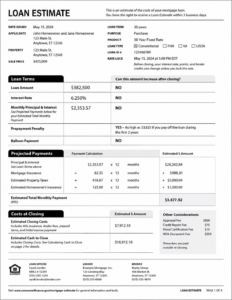 You are legally entitled to receive a Loan Estimate from your lender within three days of applying for a mortgage, which will give you a transparent, itemized breakdown of exactly how much cash you will need.
To minimize these costs, you can:
- Shop around: Origination, title, and escrow fees vary significantly between different companies.
- Ask for a seller concession: You can negotiate in your purchase contract for the seller to cover a portion of your closing costs.
- Opt for a “no-closing-cost” mortgage: The lender pays your closing costs upfront, but in exchange, they will typically charge you a slightly higher interest rate.
To estimate your exact expected closing costs by zip code, use the Bank of America Closing Costs Calculator.
For an official breakdown of your specific loan, always refer to your personalized Loan Estimate.
Notice: We have given you examples/estimates with the latest information posted that is available. Your lender and closing agent will give you the full details of what to expect at the closing of your loan.